
Sep
It’s remarkable just how much a small collection of marks can tell you about any piece of jewellery. However, look closely at a ring, necklace or bracelet made from a precious metal, and you’re likely to find a series of tiny symbols showing exactly what it is made from, its purity and where it was tested.
These symbols are UK hallmarks, and, for many items made of precious metals, they are a legal requirement. Perhaps surprisingly, this system has a much longer history than modern jewellery; in fact, hallmarks have been used for hundreds of years to protect buyers and verify the quality of precious jewellery. This article outlines this history in more detail, explaining where hallmarking came from, what jewellery hallmarks mean, and how you can read them.
What Is A Hallmark?
A hallmark is a series of marks applied to an item made from precious metal after it has been independently tested by an Assay Office. As precious metals are rarely used in their purest form and it isn’t possible to tell the exact purity of a piece of jewellery by looking at it, hallmarking provides an independent way of confirming that the metal meets required standards.
Here in the UK, items described as being made from gold, silver, platinum or palladium need to carry a legally recognised hallmark when they exceed certain weight limits. The current system is governed by the Hallmarking Act 1973.
The History Of Hallmarking
While the legislation relating to hallmarking came into place in the UK in the 1970s, hallmarking as a concept has a much longer history dating back to the 1300s and the reign of Edward I.
In 1300, Edward I introduced legislation intended to protect standards of gold and silver and prevent fraudulent or poor-quality goods from being sold. Trusted goldsmiths, known as ‘Guardians of the craft’, were tasked with checking precious metal items and applying a mark to those that met the required standard. At the time, that mark was a leopard’s head.
More hallmarks were introduced over time, and the word hallmark itself is linked to Goldsmiths’ Hall in London. Goldsmiths’ Hall became home to a permanent assay office (where precious metals could be tested and marked) from the late 15th century.
The system continued to evolve, with makers’ marks and date letters introduced to identify the goldsmith responsible for making the item and the year in which an item had been hallmarked. By the 18th and 19th centuries, Birmingham and Sheffield had become important centres for jewellery production and new assay offices were established in these cities.
The Hallmarking Act 1973
By the 20th century, hallmarking was governed by a collection of legislation that had built up over hundreds of years. The Hallmarking Act 1973 then brought much of this legislation together into a modern framework, receiving Royal Assent in 1973 and coming into effect in 1975.
The Hallmarking Act also established the British Hallmarking Council, which oversees the work of the UK’s Assay Offices and helps ensure that adequate hallmarking facilities are available.
What Do UK Hallmarks Mean?
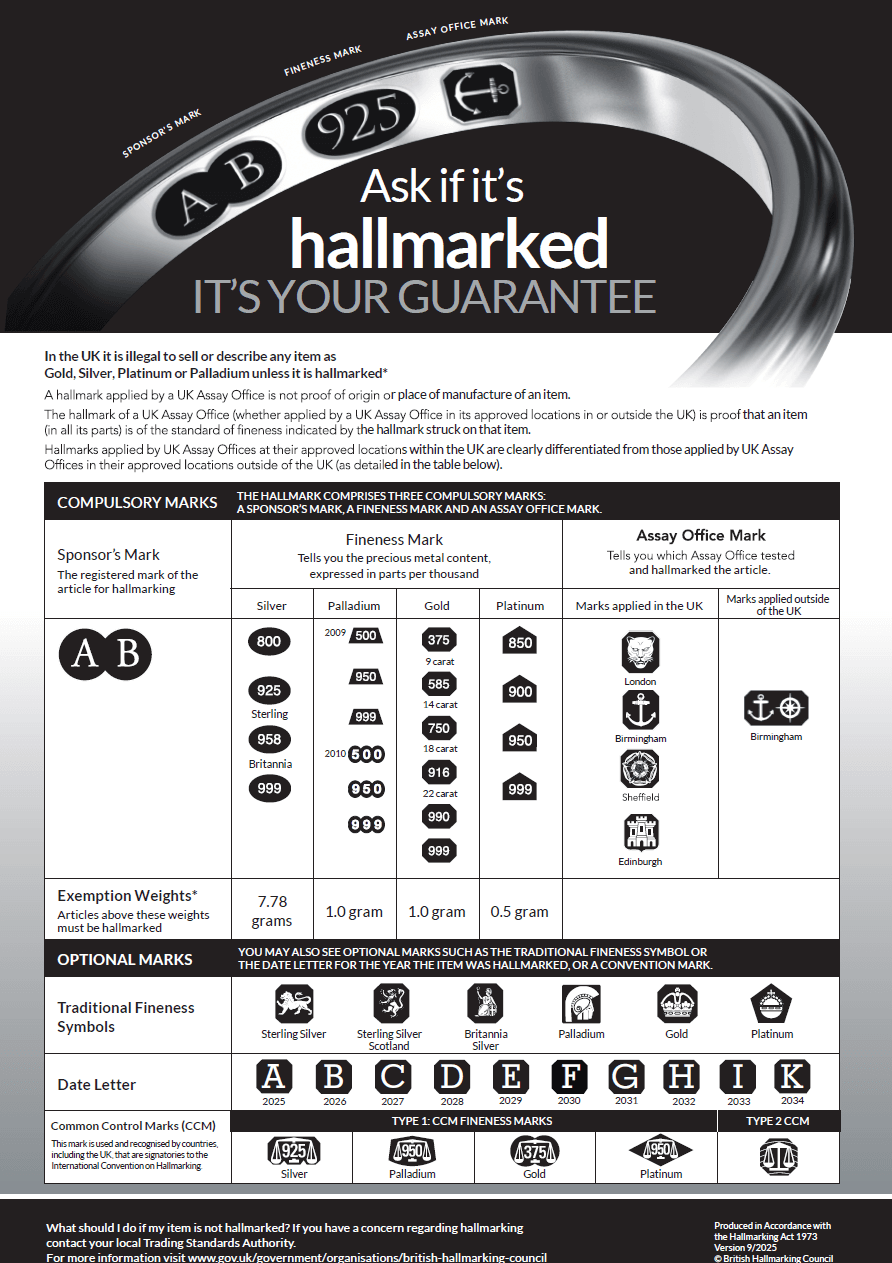
While hallmarks have changed considerably over the years, the modern system is relatively straightforward and a full UK hallmark consists of three compulsory marks:
Sponsor’s mark
The sponsor’s mark identifies the person or company responsible for submitting the item for hallmarking. It is a registered mark and unique to the sponsor. Importantly, this mark doesn’t necessarily mean they manufactured the item themselves, as manufacturers, wholesalers, retailers and importers can all act as sponsors.
Fineness mark
The fineness mark tells you how much precious metal is present in the item, expressed in parts per thousand. For example, you’ll commonly see 925 on sterling silver, which means the metal contains at least 925 parts pure silver per 1,000. The dealer’s notice available below shows the recognised fineness marks for silver, gold, palladium and platinum in more detail.
Assay Office mark
The Assay Office mark tells you where the item was tested and hallmarked.
There are currently four UK Assay Offices:
- London
- Birmingham
- Sheffield
- Edinburgh
Each has its own distinctive mark, making it possible to identify which office tested a piece.
What About Date Letters?
You may also come across a date letter as part of a set of jewellery hallmarks. Date letters are optional, but they can be particularly interesting when looking at older jewellery. They indicate the year in which an item was hallmarked, although the lettering system has changed over time.
The modern sequence of date letters includes A for 2025, B for 2026, C for 2027, and so on.
Are All Precious Metal Items Required To Be Hallmarked?
Not all precious metal items are required to be hallmarked, and there are some exemptions based on the weight of the item.
Exemption weights differ for each precious metal, and items above these weights must be hallmarked when sold or described as being made from the relevant precious metal. The current thresholds are 7.78g for silver, 1g for palladium, 1g for gold and 0.5g for platinum.
There are also specific rules and exemptions covering different types of articles, so hallmarking requirements aren’t quite as simple as saying that every piece of precious metal jewellery must carry a hallmark.
Understanding UK Hallmarks Today
While the history of hallmarking is fascinating, knowing what the marks mean is useful when buying jewellery today too. After all, a hallmark provides key information about a piece of jewellery or other precious metal item and is designed to give buyers confidence in what they are purchasing.
So, if you’re looking at a piece of gold, silver, platinum or palladium jewellery, do take a moment to look for its hallmark. You can use the marks to understand the metal’s fineness and identify where it was tested.
Here at Bonds the Jewellers, we’re proud to stock a range of fine jewellery that carries this centuries-old tradition of quality and verification. Whether you’re shopping for a special ring or a dainty necklace, our precious metal jewellery will always carry the appropriate hallmark, attesting to its quality and authenticity.

